Traditional Healers of Goa: Inside India’s Enduring Forest Medicine Culture
The Forest Remains a Pharmacy
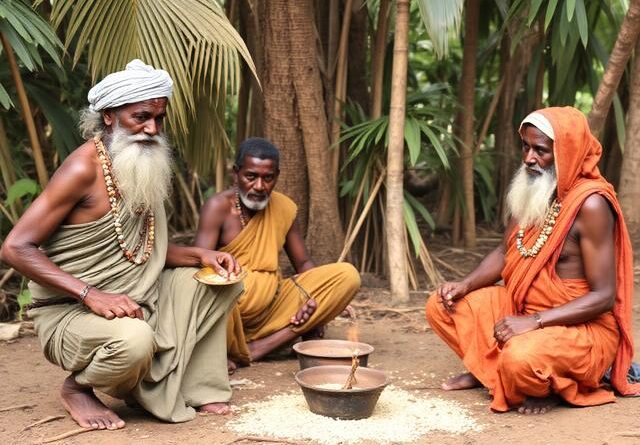
In the villages that drift across Goa like quiet sentences—unhurried, loosely punctuated, open to interpretation—traditional healers continue to occupy an improbable place in the present tense. Their huts and modest houses draw a slow procession of strangers who arrive with ailments folded into memory and hope pressed into their palms. The landscape seems to conspire in this continuity: red earth damp from monsoon runoff, groves of cashew and mango, lattices of vines that turn the hinterland into a kind of open-air dispensary.
These healers rarely charge for their work. Many refuse money outright, insisting that the service is older than commerce, older even than the narrow tar roads that now stitch the region into a more hurried sense of time. Their remedies—infusions, poultices, and powders with a grammar of their own—are fragments of a knowledge shaped by forests that once pressed closer to the villages than they do today. They operate in a space where the boundaries between duty, inheritance, and intuition blur, and where the state’s bureaucratic machinery arrives only recently, clipboard in hand, hoping to coax ancestral wisdom into the clarity of registries and research papers.
The Goa State Biodiversity Board has begun formally registering these healers: thirty or so thus far. It is an effort that suggests both urgency and hesitation, as though the knowledge might slip away entirely unless given official shape. The initiative acknowledges two realities: that modern medicine cannot yet reach every corner of the state, and certain forms of healing endure not because they resist change, but because they quietly outlast it.
The Thin Line Between Necessity and Tradition
Across the state’s interior—particularly in the southern belts where villages like Cotigao lie folded into dense canopies—healers form a parallel system of care. The nearest doctor may be hours away; the healer is a short walk down a path lit by familiarity rather than streetlights. In these spaces, the forest is not a metaphor. It is a pharmacy, a mentor, and a sometimes-unruly collaborator. Leaves, roots, and bark are collected according to rules never committed to writing, shaped instead by patterns of season, memory, and caution.
The ailments people bring are those that thread through rural life with persistence: kidney stones, jaundice, skin diseases, menstrual disorders, persistent stomach problems, and the occasional urgency of a snake or animal bite. Even in towns several kilometres removed from the forest edge, people drift toward these healers with a curiosity that borders on faith. Urban visitors arrive clutching sheaves of medical reports as though needing permission to place their trust in older ways.
Skepticism remains, of course. It hovers like humidity over the entire enterprise. Some arrive uncertain, prepared to be unconvinced. Others return after finding that the clinic, for all its charts and fluorescent lights, offered little more than a name for the ailment and a prescription that did not settle well. “Those who doubt will doubt,” one healer remarks with a shrug typical of a craft that depends on neither evangelism nor persuasion. The results, they insist, speak louder than any reassurance they could offer.
But the practice is not merely botanical. Before venturing into the forest, many healers observe a small ritual—sometimes a whispered invocation, sometimes a moment of stillness. It is not a performance of belief so much as a tacit acknowledgement of the forest’s unpredictable temperament. Nature gives, but not always freely. There is a manner in which one asks.
The Cost of Disappearing Forests
The geography of Goa is changing, as all geographies touched by highways and real estate eventually do. In many villages, the forest has retreated, reshaping the healer’s relationship to the materials of their craft. Bark that once grew a short climb uphill now travels wrapped in plastic from markets where it costs more than a symbolic offering. The narrow, intuitive exchanges between forest and healer have been replaced, in part, by negotiations with vendors and the uncertainties of supply chains.
This shift is not merely logistical. It alters the moral architecture of the practice. When ingredients must be purchased rather than gathered, the line between service and commerce becomes more porous. Most healers refuse to cross it. The refusal is not romantic but deliberate: the craft is inherited, and inheritance carries obligations, not invoices. Money, they fear, can distort intention, and intention is the unseen ingredient in every remedy they prepare.
For some elders, the greater worry is the fading of succession. Younger family members often prefer salaried work, urban certainty, and the quiet anonymity of employment that does not require trekking into forests or memorising the textures of leaves. Many in the older generation speak of their knowledge as if it were an endangered species—resilient, but only just. Without recognition, without a sense of collective ownership, it may not survive the century.
This grim arithmetic is part of what drove the Biodiversity Board to begin the registration process. The initiative aims to give healers not only identity cards, but also a measure of dignity—something the state can seldom confer without simultaneously threatening to reshape its recipient. The Board now plans to work with national organizations to explore the possibility of patenting certain formulations, a gesture at protection that also acknowledges the precariousness of knowledge held entirely in memory.
“Their real treasure is their traditional knowledge,” one official observes. “Their real wealth is preserving it.” His words rise from a mixture of admiration and alarm. He recounts meeting an elderly healer who admitted that no one in his family wished to learn the craft. The official describes the moment as quietly devastating: a lineage poised to vanish not with a dispute or a storm, but with a simple lack of interest.
The Medical Establishment Looks On
In the broader mosaic of India’s healthcare system—where allopathy, homoeopathy, Ayurveda, naturopathy, and dozens of regional traditions overlap—herbal healing occupies a shadowed but undeniable niche. Some doctors speak of it with caution, others with guarded respect. A senior medical practitioner in Goa points out that herbal medicine has its place when used with knowledge, but warns that inheritance alone cannot substitute for understanding. Misapplication, he notes, is as old as the practice itself.
Yet the medical establishment increasingly recognizes that dismissing these healers outright would be a disservice to both science and society. Their practices endure because they meet needs that modern medicine struggles to reach—geographically, financially, and culturally. The future, some argue, lies in research that chooses not to overwrite tradition but to understand it.
Such a partnership, if it ever fully forms, would require humility on both sides: the state acknowledging that some forms of wisdom do not fit neatly into policy frameworks, and healers accepting that survival may require a translation of sorts—into research, documentation, and the shared language of institutions.
For now, the forest continues to whisper its instructions, and the healers continue to listen. Their remedies travel not through textbooks but through practice, memory, and the soft thud of footsteps on a forest path. Their patients arrive in quiet desperation and depart with quieter hope. And the villages, unbothered by their own slow pace, remain repositories of a knowledge that persists despite the world’s insistence on moving on without it.
If you think this information is useful, you can…
Get updates and read additional stories on the Health Orbit Fan Page.
For Guest posts, sponsored posts and other details, please click the ‘Contact Us’ page.