

Overthinking vs. Mindfulness: Rewiring Your Mind for a Calmer, Happier Life
“The mind is a wonderful servant but a terrible master.” This timeless wisdom captures the difference between overthinking and mindfulness. Both involve thinking, but they lead us in opposite directions. One traps us in cycles of fear, doubt, and regret. The other grounds us in the present, helping us respond to life with clarity and confidence.
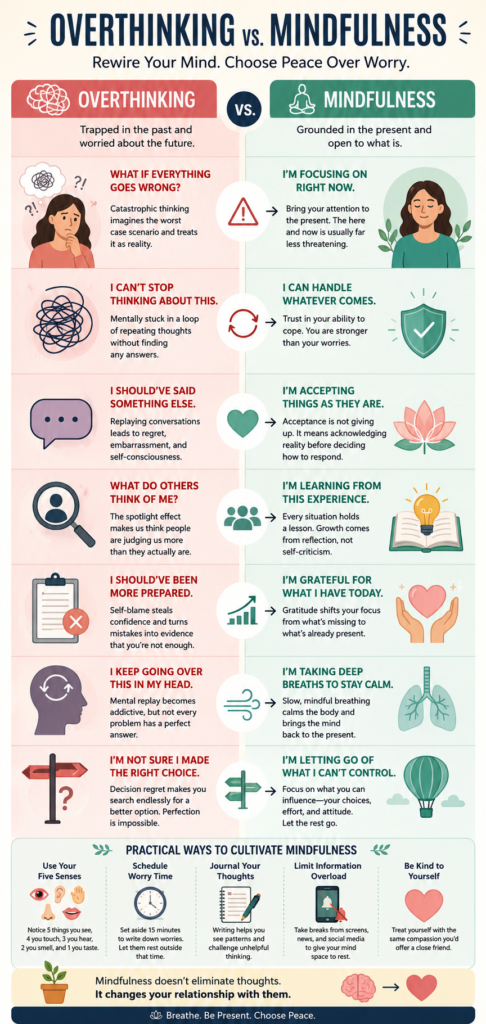
The infographic above beautifully contrasts these two mental states. On one side lies the exhausting world of overthinking—filled with “what ifs,” self-criticism, and endless mental replay. On the other lies mindfulness, where acceptance, awareness, and intentional living replace worry and mental noise.
Understanding the difference between these two ways of thinking can transform your emotional well-being, relationships, productivity, and overall quality of life.
What Is Overthinking?
Overthinking is the habit of dwelling excessively on situations, conversations, decisions, or future possibilities. Instead of solving problems, it magnifies them.
People who overthink often mistake worrying for preparation. They believe that if they analyze every possibility, they can prevent mistakes or future pain. In reality, excessive thinking often leads to:
- Anxiety
- Decision paralysis
- Poor sleep
- Reduced confidence
- Emotional exhaustion
- Difficulty concentrating
Overthinking generally falls into two categories:
Rumination: Constantly replaying past events.
Worry: Obsessing about future uncertainties.
Neither helps us control reality.
The Voice of Overthinking
“What if everything goes wrong?”
This question is the hallmark of catastrophic thinking.
Instead of evaluating realistic possibilities, the mind jumps directly to worst-case scenarios. A job interview becomes certain rejection. A delayed text message becomes evidence that someone is upset. A small mistake becomes a career-ending disaster.
The brain begins treating imagined dangers as if they are real.
“I can’t stop thinking about this.”
Overthinking creates a mental loop.
The same thoughts replay repeatedly without reaching a conclusion. Rather than producing solutions, the brain simply recycles uncertainty.
Ironically, the harder we try to stop thinking, the stronger the thoughts often become.
“I should’ve said something else.”
Many people replay conversations for hours or even days.
- Why did I say that?
- Did I sound awkward?
- Did they misunderstand me?
This hindsight analysis rarely changes anything. Instead, it increases embarrassment and self-consciousness.
“What do others think of me?”
Social overthinking is extremely common.
We assume people are constantly judging our appearance, words, or actions. Psychology calls this the spotlight effect—the tendency to overestimate how much attention other people pay to us.
The truth is that most people are focused on their own lives.
“I should’ve been more prepared.”
Self-blame often accompanies overthinking.
Instead of learning from mistakes, we criticize ourselves relentlessly.
Healthy reflection asks:
“What can I improve next time?”
Overthinking says:
“I failed because I’m not good enough.”
The difference is profound.
“I keep going over this in my head.”
Mental replay can become addictive.
The brain believes that repeating a problem will eventually uncover a perfect answer. But many situations don’t have perfect answers.
Sometimes, the healthiest choice is to let the thought pass.
“I’m not sure I made the right choice.”
Decision regret keeps us trapped.
Even after making a choice, the overthinking mind searches endlessly for evidence that another option would have been better.
Psychologists call this maximizing, where people constantly seek the perfect decision rather than accepting a good one.
Perfection is impossible.
The Mindfulness Alternative
Mindfulness doesn’t mean ignoring problems.
It means responding to them without becoming overwhelmed by them.
Mindfulness is the practice of paying attention to the present moment with openness, curiosity, and without judgment.
Let’s examine how mindfulness transforms each overthinking pattern.
“I’m focusing on right now.”
Mindfulness redirects attention away from imaginary futures and into the present.
Ask yourself:
- What can I see?
- What can I hear?
- What am I doing at this moment?
The present moment is usually far less threatening than the stories our minds create.
“I can handle whatever comes.”
Notice the difference.
Mindfulness doesn’t claim that nothing bad will happen.
Instead, it builds confidence in your ability to cope if challenges arise.
This shift replaces fear with resilience.
Life becomes less about predicting every outcome and more about trusting yourself.
“I’m accepting things as they are.”
Acceptance is often misunderstood.
Acceptance is not giving up.
It means acknowledging reality before deciding how to respond.
When we resist reality, we create additional suffering.
When we accept reality, we conserve emotional energy for meaningful action.
“I’m learning from this experience.”
Every setback contains information.
Mindfulness encourages growth instead of self-punishment.
Rather than asking:
“Why am I like this?”
Ask:
“What can this situation teach me?”
This mindset encourages resilience rather than shame.
“I’m grateful for what I have today.”
Gratitude shifts attention from scarcity to abundance.
Overthinking constantly highlights what’s missing.
Mindfulness notices what’s already present.
Research consistently suggests that practicing gratitude can improve mood, reduce stress, and enhance overall well-being.
Simple daily gratitude practices can gradually reshape habitual thinking patterns.
“I’m taking deep breaths to stay calm.”
Breathing is one of the fastest ways to influence the nervous system.
When anxious:
- Breathing becomes shallow.
- Heart rate increases.
- Muscles tighten.
Slow, controlled breathing signals safety to the body.
One simple technique:
- Inhale for four seconds.
- Hold for four seconds.
- Exhale for six seconds.
Repeat several times.
The mind often follows where the breath leads.
“I’m letting go of what I can’t control.”
Perhaps this is mindfulness’s greatest lesson.
Many of our worries involve things outside our control:
- Other people’s opinions
- The past
- Future uncertainty
- Unexpected events
Mindfulness encourages focusing only on what can actually be influenced:
- Your attitude
- Your effort
- Your habits
- Your choices today
This shift creates tremendous psychological freedom.
Why Overthinking Happens?
Overthinking isn’t a personality flaw.
It’s often the brain’s attempt to protect us.
Our minds evolved to detect threats. Thousands of years ago, anticipating danger increased survival.
Today, however, our brains often react to emails, deadlines, social interactions, or uncertainty as though they were life-threatening.
Understanding this helps us respond with compassion instead of frustration.
Practical Ways to Become More Mindful
Building mindfulness is like strengthening a muscle. Small, consistent practices are more effective than occasional intense efforts.
Here are a few habits you can start today:
1. Practice the Five-Senses Exercise
When your thoughts race, pause and notice:
- Five things you can see
- Four things you can touch
- Three things you can hear
- Two things you can smell
- One thing you can taste
This gently anchors your attention in the present.
2. Schedule “Worry Time”
Instead of worrying all day, set aside 15 minutes in the evening to write down concerns. If worries appear outside that window, remind yourself you’ll return to them later. This helps reduce constant rumination.
3. Journal Your Thoughts
Writing thoughts on paper often reveals patterns. You may notice recurring fears that never actually happen, making them easier to challenge.
4. Limit Information Overload
Constant notifications, news updates, and social media can fuel overthinking. Create intentional breaks from screens to give your mind room to rest.
5. Be Kind to Yourself
Treat yourself with the same compassion you would offer a close friend. Mistakes are opportunities for learning, not proof of failure.
The Journey from Overthinking to Mindfulness
No one becomes mindful overnight. Even experienced practitioners occasionally fall into worry, self-doubt, or rumination. The goal isn’t to eliminate thoughts but to change your relationship with them.
When you notice yourself spiraling into “What if everything goes wrong?” gently redirect your attention toward “What can I do right now?”
That small shift can make a remarkable difference.
Mindfulness doesn’t promise a life without challenges. Instead, it offers something far more valuable: the ability to meet life’s uncertainties with calm, clarity, and self-trust.
In a world that constantly encourages us to think faster, plan further, and worry more, mindfulness reminds us that peace is found not in controlling every outcome, but in fully inhabiting the present moment.
The next time your mind begins replaying yesterday or fearing tomorrow, pause. Take a slow, deep breath. Notice where you are. Focus on what you can control today. That single mindful moment may be the beginning of a healthier, happier relationship with your own mind.
If you think this information is useful, you can…
Get updates and read additional stories on the Health Orbit Fan Page.
For Guest posts, sponsored posts and other details, please click the ‘Contact Us’ page.