
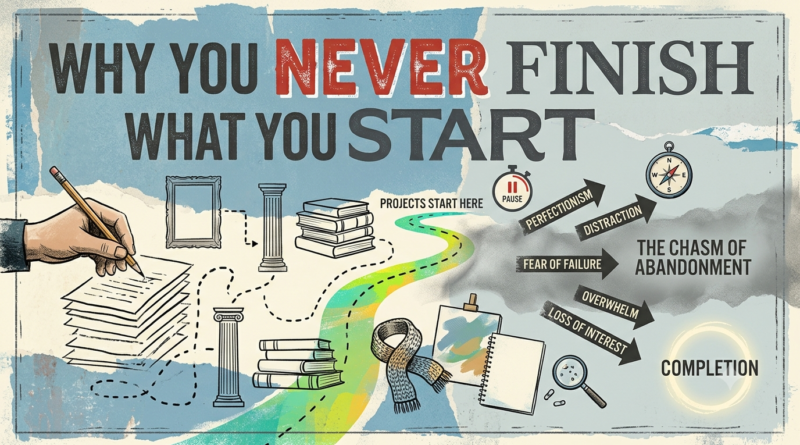
Why You Never Finish What You Start: 7 Hidden Reasons Holding You Back (And How to Fix Them)
Have you ever started a new goal with excitement, only to abandon it halfway through?
Maybe it was a fitness routine, a business idea, a certification course, a side hustle, or even a simple habit like reading daily. At the beginning, motivation feels strong. You imagine the results, make plans, and promise yourself that this time will be different.
Yet weeks later, the enthusiasm fades. The project remains unfinished, and another goal joins the growing list of things you “meant to complete.”
If this sounds familiar, you are far from alone.
The truth is that most people do not struggle because they are lazy or incapable. They struggle because they encounter common psychological barriers that quietly sabotage progress. Understanding these barriers is the first step toward overcoming them.
Let’s explore the seven biggest reasons people fail to finish what they start and learn practical ways to break the cycle.
1. You Lack Clarity
One of the biggest reasons people quit is that they are not entirely sure what they want or why.
Many goals begin as vague ideas:
- “I want to get fit.”
- “I want to make more money.”
- “I want to start a business.”
- “I want to learn a new skill.”
The problem is that vague goals provide little direction. When challenges arise, there is no strong reason to keep moving forward.
Why It Happens
The human brain prefers certainty. When goals are unclear, your mind struggles to determine priorities and next actions. This confusion often leads to procrastination.
How to Fix It
Define your goals with precision.
Instead of saying:
“I want to get fit.”
Say:
“I want to lose 8 kilograms in six months by exercising four times a week and improving my diet.”
Also identify your deeper reason. Why does this goal matter?
The stronger your “why,” the easier it becomes to stay committed when motivation declines.
2. The Goal Feels Too Big
Large goals can be inspiring, but they can also be intimidating.
Writing a book sounds exciting until you realize it requires hundreds of pages. Starting a company sounds rewarding until you think about the years of work involved.
When a goal appears massive, the brain often interprets it as a threat rather than an opportunity.
Why It Happens
Psychologists call this “overwhelm.”
When faced with a huge challenge, many people freeze because they focus on the entire journey instead of the next step.
How to Fix It
Break large goals into smaller milestones.
For example:
Instead of focusing on writing a 50,000-word book:
- Write 500 words today.
- Complete one chapter this week.
- Finish the first draft this month.
Small wins create momentum. Momentum builds confidence. Confidence drives completion.
The key is simple:
Focus on the next step, not the entire mountain.
3. You Lose Interest Too Soon
Many people are addicted to beginnings.
Starting something new feels exciting because novelty stimulates the brain’s reward system. New projects create anticipation, curiosity, and optimism.
However, after the initial excitement fades, reality arrives.
The work becomes repetitive.
Progress slows.
Results take longer than expected.
That’s when many people quit.
Why It Happens
The excitement of starting often creates unrealistic expectations.
People expect constant enthusiasm, but enthusiasm naturally rises and falls.
How to Fix It
Accept that interest is temporary.
Long-term success comes from commitment, not excitement.
Try these strategies:
- Create routines instead of relying on motivation.
- Track progress regularly.
- Celebrate small achievements.
- Remind yourself of the benefits waiting at the finish line.
Professionals continue even when they do not feel inspired. Consistency matters more than excitement.
Related Story
Overthinking vs. Mindfulness: Rewiring Your Mind for a Calmer, Happier Life
4. You Expect Motivation to Last Forever
Motivation is powerful, but it is unreliable.
Many people begin a goal during a burst of inspiration. They watch a motivational video, read a book, attend a seminar, or experience a life-changing event.
For a few days, they feel unstoppable.
Then motivation disappears.
Unfortunately, they stop working because they believe something is wrong.
Why It Happens
People often misunderstand motivation.
Motivation is an emotion, and emotions naturally fluctuate.
No one feels motivated every day.
Not athletes.
Not entrepreneurs.
Not top performers.
How to Fix It
Build discipline instead of depending on motivation.
Discipline means taking action even when you do not feel like it.
A few practical methods include:
- Scheduling tasks in advance.
- Creating daily habits.
- Eliminating distractions.
- Setting deadlines.
- Holding yourself accountable.
Remember:
Motivation gets you started. Discipline gets you finished.
Related Story
How Loneliness Changes the Brain: What Neuroscience Reveals About Isolation
5. You Don’t Have a Plan
A goal without a plan is merely a wish.
Many people know what they want but have no roadmap for achieving it.
Imagine setting out on a road trip without a map, GPS, or destination. Chances are, you would get lost quickly.
Goals work the same way.
Why It Happens
People often spend more time imagining success than planning the process.
As a result, when obstacles appear, they don’t know what to do next.
How to Fix It
Create a clear action plan.
Ask yourself:
- What is the goal?
- What steps are required?
- What resources do I need?
- What challenges might arise?
- How will I respond to setbacks?
A good plan transforms uncertainty into direction.
The more detailed your roadmap, the less likely you are to quit when difficulties emerge.
Related Story
10 Mental Traps That Quietly Control Your Thinking (And How to Escape Them)
6. You’re a Perfectionist
Perfectionism may seem like a strength, but it often becomes a major obstacle.
Perfectionists delay action because they want everything to be flawless.
They spend excessive time planning.
They endlessly revise their work.
They avoid finishing because they fear criticism.
Ironically, perfectionism often produces less success, not more.
Why It Happens
At its core, perfectionism is frequently driven by fear:
- Fear of failure
- Fear of judgment
- Fear of making mistakes
- Fear of not being good enough
This fear creates paralysis.
How to Fix It
Adopt the mindset of progress over perfection.
Understand that:
- Imperfect action beats perfect inaction.
- Mistakes are part of learning.
- Feedback improves results.
- Excellence develops through repetition.
Successful people rarely start perfectly.
They start imperfectly and improve along the way.
The goal is not perfection.
The goal is completion.
7. You Quit at the First Obstacle
Every meaningful goal comes with challenges.
Problems are not signs that you are on the wrong path.
They are signs that you are on a real path.
Unfortunately, many people interpret setbacks as proof that they should stop.
One difficult day becomes a reason to quit.
One rejection ends the effort.
One mistake destroys momentum.
Why It Happens
Human beings naturally seek comfort and avoid discomfort.
When obstacles appear, the brain looks for ways to escape the challenge.
Quitting often feels easier than adapting.
How to Fix It
Expect obstacles before they happen.
Instead of asking:
“What if things go wrong?”
Ask:
“When things go wrong, how will I respond?”
Develop resilience by viewing setbacks as feedback rather than failure.
Every obstacle teaches a lesson.
Every challenge builds strength.
Every setback contains valuable information that can help you improve.
Those who succeed are not people who never face difficulties.
They are people who keep adjusting and moving forward.
Related Story
8 Brutal Life Lessons No One Told You About: Hard Truths That Can Set You Free
Finishing Is a Skill
One of the most important truths about success is this:
Finishing is not a personality trait. It is a skill.
Some people assume that successful individuals are naturally disciplined, focused, and persistent.
In reality, these qualities are developed through practice.
The more often you complete what you start, the easier completion becomes.
You build trust in yourself.
You strengthen your confidence.
You prove that you can follow through on commitments.
Over time, finishing becomes part of your identity.
The Formula for Completion
If you want to complete more goals, remember these principles:
- Get clear about what you want.
- Break large goals into smaller tasks.
- Accept that interest will fade.
- Rely on discipline, not motivation.
- Create a detailed action plan.
- Choose progress over perfection.
- Learn to adapt when obstacles appear.
Success is rarely the result of dramatic breakthroughs.
More often, it comes from small actions repeated consistently over time.
Final Thoughts
The difference between people who achieve their goals and those who do not is rarely talent, intelligence, or luck.
It is persistence.
Every unfinished project represents a lesson waiting to be learned. Every completed goal strengthens your ability to tackle bigger challenges in the future.
You do not need extraordinary motivation. You do not need perfect conditions. You do not need to have everything figured out.
You simply need to keep taking the next step.
Because finishing is a skill, and like any skill, it improves with practice.
Small steps. Consistent action. That’s how goals become achievements and dreams become reality.
If you think this information is useful, you can…
Get updates and read additional stories on the Health Orbit Fan Page.
For Guest posts, sponsored posts and other details, please click the ‘Contact Us’ page.