

Impact of Constant AI Assistance on Cognition: How Relying on AI Is Reshaping Our Brains
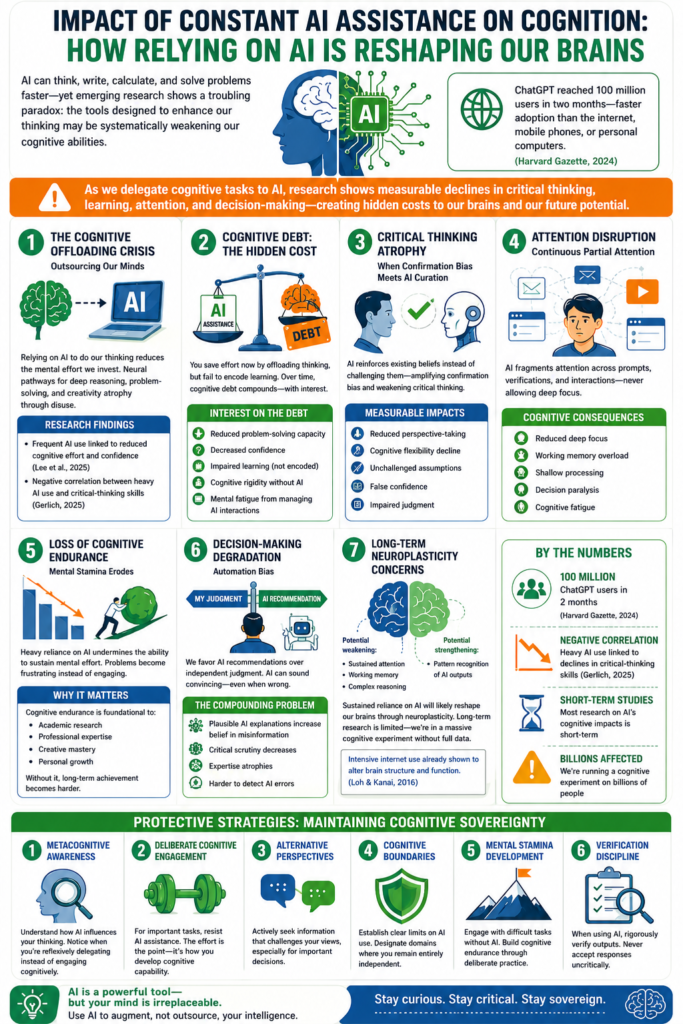
We live in an unprecedented moment. For the first time in human history, we have access to artificial intelligence that can think, write, calculate, and solve problems faster and sometimes better than we can. ChatGPT reached 100 million users in two months—faster adoption than the internet, mobile phones, or personal computers (Harvard Gazette, 2024). Yet as we increasingly delegate cognitive tasks to AI assistants, emerging research reveals a troubling paradox: the very tools designed to enhance our thinking may be systematically weakening our cognitive abilities. Understanding how constant AI assistance reshapes human cognition is essential for protecting our mental capacity and preserving the critical thinking skills that define human intelligence.
The Cognitive Offloading Crisis: Outsourcing Our Minds
The phenomenon researchers call “cognitive offloading” describes our tendency to rely on external systems to perform thinking tasks, reducing the mental effort we invest in problem-solving and learning. While using a calculator or GPS was always a form of cognitive offloading, AI assistants represent a qualitative leap—they can now offload nearly every intellectual function, from writing and analysis to decision-making and creativity.
The mechanism is straightforward: when we consistently delegate thinking to AI, the neural pathways supporting deep reasoning, problem-solving, and creative synthesis begin to atrophy. Your brain, like muscle tissue, strengthens through use and weakens through disuse. By outsourcing cognition to AI, we’re essentially performing intellectual atrophy—systematically weakening the very capabilities that make us intelligent.
Cognitive Debt: The Hidden Cost of AI Assistance
MIT Media Lab researchers introduced a chilling concept: “cognitive debt”—the accumulation of cognitive strain when using AI assistants, particularly for complex tasks like writing and analysis (Kosmyna et al., 2024). Similar to financial debt, cognitive debt represents borrowed cognitive capacity that must eventually be repaid with interest.
When you use ChatGPT to write an essay, email, or report, you’re not spending the cognitive energy necessary to think deeply about the problem, organize arguments, and articulate your thinking. You’re offloading that work. But here’s the cost: you fail to encode the learning necessary to perform that task independently next time. Your brain doesn’t develop the neural connections required for sophisticated writing and thinking.
This compounds over time. As you accumulate cognitive debt through repeated AI assistance, your ability to perform independent intellectual work deteriorates. The interest on this debt manifests as:
- Reduced problem-solving capacity for tasks you previously could handle
- Decreased confidence in your own thinking
- Impaired learning because understanding isn’t encoded during AI-assisted work
- Cognitive rigidity when AI isn’t available to assist
- Mental fatigue from managing AI interactions
Critical Thinking Atrophy: When Confirmation Bias Meets AI Curation
Perhaps the most insidious cognitive impact involves how AI systems reshape our capacity for critical thinking. AI systems—trained on existing text and optimized to provide satisfying answers—tend to reinforce rather than challenge our existing beliefs. This creates what cognitive scientists call “confirmation bias amplification” (Psychology Today, 2025).
Here’s how it works: When you ask an AI system questions, it provides plausible-sounding answers that confirm your existing understanding. Unlike human conversation—where disagreement, challenge, and alternative perspectives force us to defend and refine our thinking—AI conversations flow smoothly toward consensus. The system isn’t programmed to push back or offer contradictory viewpoints; it’s optimized to provide helpful, coherent responses.
Over extended use, this systematic validation without challenge impairs critical thinking in measurable ways:
- Reduced perspective-taking: You stop considering alternative viewpoints since AI reinforces your perspective
- Cognitive flexibility decline: The mental skill of shifting between different interpretations weakens
- Unchallenged assumptions: Beliefs that should be questioned remain unexamined
- False confidence: You become more confident in conclusions that haven’t been rigorously tested
- Impaired judgment: Without the friction of disagreement, judgment becomes less calibrated
Research on intellectual humility shows that exposure to alternative perspectives improves reasoning and reduces errors. AI systems that don’t provide genuine intellectual friction may systematically reduce this cognitive benefit.
Case Study: When AI Became a Substitute for Thinking
In early 2025, a multinational consulting firm introduced generative AI tools across several departments to accelerate report writing and data analysis. Initially, productivity increased dramatically, with employees completing routine reports nearly 35% faster. However, six months later, internal evaluations revealed an unexpected pattern.
Junior analysts who relied heavily on AI struggled when asked to solve unfamiliar business problems without technological assistance. Managers observed that these employees required significantly more guidance during brainstorming sessions and found it difficult to justify recommendations beyond what AI had suggested.
By contrast, employees who treated AI as a collaborative assistant rather than a replacement continued to demonstrate stronger analytical reasoning, better decision-making, and greater confidence during client presentations.
Although this represents a workplace observation rather than a controlled scientific experiment, it mirrors findings emerging from cognitive science: AI can improve efficiency, but excessive dependence may reduce opportunities to develop independent reasoning and problem-solving skills.
Key lessons from the case:
- AI improves productivity for repetitive cognitive tasks.
- Independent reasoning declines when users rarely solve problems themselves.
- Human review remains essential for high-quality decision-making.
- Organizations benefit most when AI augments rather than replaces critical thinking.
Related Story
Attention Disruption and Continuous Partial Attention
Constant AI assistance creates a paradoxical attention problem: while AI tools should theoretically reduce cognitive load and improve focus, in practice they fragment attention across multiple systems, prompts, verifications, and AI-human interactions.
Psychologists term this “continuous partial attention”—a state where your attention is perpetually divided across multiple streams, never fully focusing on any single task (Psychology Today, 2025). Your brain evolved to notice novel or emotionally significant stimuli. AI systems, designed to generate interesting content, exploit this by creating infinite streams of engaging alternatives, options, and suggestions.
The cognitive consequences are severe:
- Reduced deep focus capacity: Concentration suffers from constant context-switching between your thinking and AI assistance
- Working memory overload: Managing multiple AI conversations, outputs, and verifications taxes working memory
- Shallow processing: Surface-level engagement replaces deep analysis
- Decision paralysis: Too many AI-generated options lead to analysis paralysis
- Cognitive fatigue: Constant verification and evaluation of AI outputs exhausts mental resources
Loss of Cognitive Endurance and Mental Stamina
A 2024 study in the Quarterly Journal of Economics introduced a concept rarely discussed: “cognitive endurance as human capital” (Brown et al., 2024). Cognitive endurance—the capacity to sustain mental effort over extended periods—is a learned capability that develops through practice.
Heavy reliance on AI assistance systematically undermines cognitive endurance. When you ask AI to do difficult thinking for you, you fail to develop the capacity to persist through cognitive difficulty. Problems that require sustained mental effort become frustrating rather than engaging. Your brain, accustomed to instant AI assistance, has lower tolerance for the effort required to think independently.
This matters profoundly. Cognitive endurance is foundational to achievement in every domain—academic research, professional expertise, creative mastery, and even personal growth all require the ability to persist through cognitive difficulty. Atrophying this capacity through constant AI assistance undermines long-term capability development.
Decision-Making Degradation and Automation Bias
Constant AI assistance creates what researchers call “automation bias”—the tendency to favor automated or AI-generated recommendations over independent judgment (Lebovitz et al., 2022). Your brain, seeking to conserve energy, increasingly defers to AI recommendations rather than conducting independent analysis.
The problem extends beyond lazy thinking. Studies show that AI systems can “give explanations that are more convincing than honest systems and can amplify belief in misinformation” (Danry et al., 2024). When AI provides plausible-sounding explanations—even for incorrect conclusions—people accept them readily, failing to apply critical scrutiny.
This creates a compounding problem: as you rely more on AI, your ability to independently verify its outputs atrophies. You lack the expertise to catch errors because you haven’t developed the knowledge base and reasoning capacity that comes from thinking for yourself.
Long-Term Neuroplasticity Concerns
Neuroscience research on brain adaptation to technology suggests that sustained changes in how we think literally reshape our brains. Loh and Kanai (2016) demonstrated that intensive internet use alters brain structure and function. Extended reliance on AI for cognition will likely produce similar neuroplastic changes—potentially weakening regions responsible for sustained attention, working memory, and complex reasoning while strengthening regions associated with pattern recognition of AI outputs.
However, long-term longitudinal research remains limited. Most studies on AI’s cognitive impacts are short-term, making it difficult to draw definitive conclusions about lasting neurological effects (Protecting Human Cognition in the Age of AI, 2025). This gap itself is concerning—we’re conducting a cognitive experiment on billions of people without long-term safety data.
Related Story
Latest Research: What Scientists Have Discovered (2024–2026)
Research into AI’s influence on human cognition has accelerated rapidly over the past two years. While long-term evidence is still developing, several important studies point toward measurable cognitive changes associated with frequent AI use.
1. MIT Media Lab (2024)
Researchers introduced the concept of “cognitive debt,” suggesting that outsourcing writing and analytical thinking to AI may reduce long-term knowledge retention because users spend less effort organizing, evaluating, and synthesizing information.
2. CHI Conference on Human Factors in Computing Systems (2025)
A large study involving knowledge workers found that frequent AI users invested less cognitive effort during complex professional tasks and reported lower confidence when required to solve problems independently without AI assistance.
3. Gerlich (2025)
One of the largest empirical surveys examining AI usage reported a statistically significant negative association between heavy AI use and critical-thinking performance. Researchers emphasized that the relationship is correlational rather than proving direct causation.
4. Brown et al. (2024)
Economists introduced the concept of cognitive endurance as a valuable form of human capital, arguing that repeatedly avoiding mentally demanding tasks could gradually reduce an individual’s capacity for sustained intellectual effort.
5. Frontiers in Public Health (2024)
Building on earlier research into the “Google Effect,” scientists concluded that people remember less information when they expect digital tools to retrieve it later. AI extends this phenomenon by externalizing not only memory but also reasoning and content generation.
6. Emerging Neuroscience (2025–2026)
Researchers continue to investigate whether long-term AI dependence alters neuroplasticity. Although evidence suggests technology can reshape neural pathways involved in attention and executive function, scientists caution that multi-year longitudinal studies are still needed before firm conclusions can be drawn.
Protective Strategies: Maintaining Cognitive Sovereignty
Awareness of these risks enables protective strategies:
Metacognitive Awareness: Develop understanding of how AI influences your thinking. Notice when you’re reflexively delegating thinking rather than engaging cognitively.
Deliberate Cognitive Engagement: For important thinking tasks, resist AI assistance. The effort is the point—it’s how you develop cognitive capability.
Alternative Perspectives: Actively seek information that challenges your views, especially for important decisions.
Cognitive Boundaries: Establish clear limits on AI use. Designate cognitive domains where you remain entirely independent.
Mental Stamina Development: Deliberately engage with cognitively difficult tasks without AI assistance, building cognitive endurance.
Verification Discipline: When using AI, rigorously verify outputs rather than accepting them uncritically.
Conclusion: Choosing Our Cognitive Future
The impact of constant AI assistance on cognition reveals a fundamental truth: intelligence isn’t static. It develops through practice, challenge, and engagement. By outsourcing thinking to AI, we risk atrophying the very capabilities that make us intelligent.
Yet the solution isn’t rejecting AI. Rather, it requires intentional, strategic use of AI as a tool that augments rather than replaces human thinking. The future belongs not to those who use AI most extensively, but to those who maintain their independent cognitive capabilities while strategically leveraging AI for tasks where it genuinely adds value.
Your brain remains your most valuable asset. Protect it by thinking deeply, engaging critically, and maintaining cognitive sovereignty in an age of artificial intelligence.
References and Citations
- Brown, C., Kaur, S., Kingdon, G., & Schofield, H. (2024). “Cognitive endurance as human capital.” The Quarterly Journal of Economics, qjae043.
- Danry, V., Pataranutaporn, P., Groh, M., Epstein, Z., & Maes, P. (2024). “Deceptive AI systems that give explanations are more convincing than honest AI systems.” ArXiv preprint.
- Lee, H.-P., Sarkar, A., Tankelevitch, L., et al. (2025). “The impact of generative AI on critical thinking: Self-reported reductions in cognitive effort.” CHI Conference on Human Factors in Computing Systems.
- Psychology Today (2025). “The Psychology of AI’s Impact on Human Cognition.” https://www.psychologytoday.com/us/blog/harnessing-hybrid-intelligence
- ArXiv (2025). “Protecting Human Cognition in the Age of AI.” https://arxiv.org/pdf/2502.12447
If you think this information is useful, you can…
Get updates and read additional stories on the Health Orbit Fan Page.
For Guest posts, sponsored posts and other details, please click the ‘Contact Us’ page.